
How many leads did your business lose last month? Not lose to competitors—lose to process failures. Leads that came in but weren't followed up. Leads assigned but forgotten. Leads that received one email and never heard from you again.
According to Credofy, the average business loses up to 73% of leads due to poor management. That's not a rounding error. That's three quarters of your pipeline vanishing before it has a chance to convert.
Lead management software eliminates this leakage. By capturing every lead, routing them instantly, and ensuring consistent follow-up, you transform lead management from a liability into a competitive advantage.
The Lead Leakage Problem
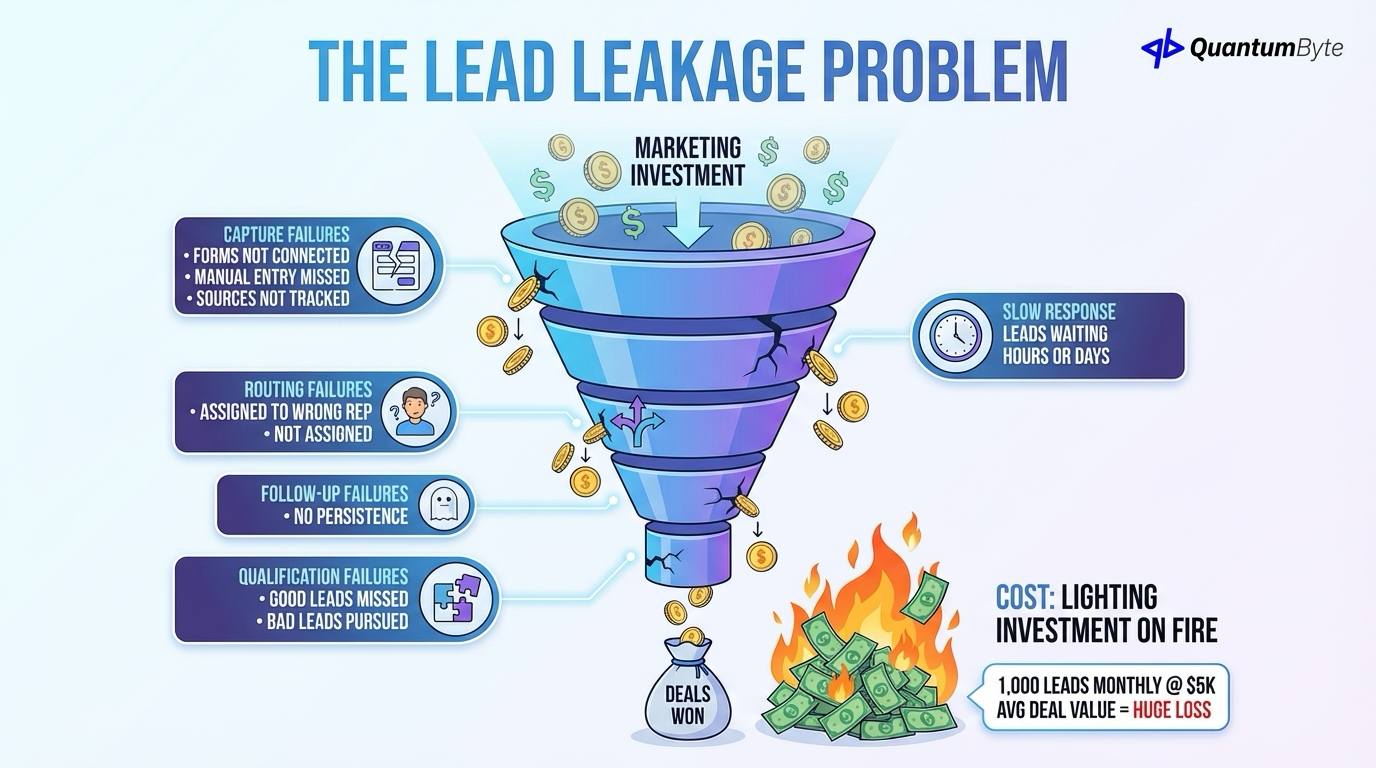
Every lead has a cost. Marketing spend, content creation, advertising, events—you invested to generate that interest. When leads leak out of your pipeline, you're lighting that investment on fire.
Where leads leak:
- Capture failures: Forms not connected, manual entry missed, sources not tracked
- Slow response: Leads waiting hours or days for contact
- Routing failures: Leads assigned to wrong rep or not assigned at all
- Follow-up failures: Initial contact but no persistence
- Qualification failures: Good leads not identified, bad leads over-pursued
For a business generating 1,000 leads monthly with $5K average deal value, poor lead management costs, a lot.
The Revenue Impact of Lead Management
The flip side of leakage is opportunity:
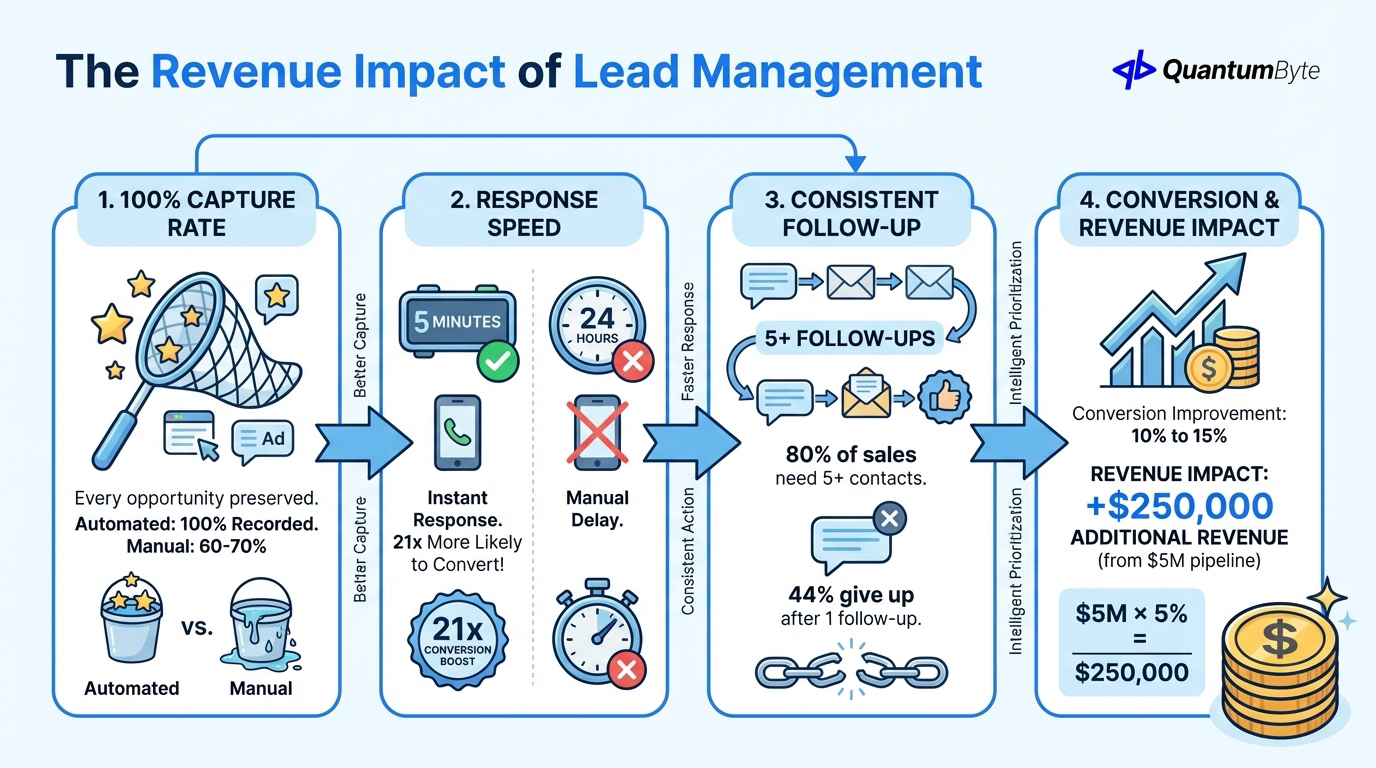
100% Capture Rate (vs. 60-70% Manual)
Every lead captured = Every opportunity preserved. Lead management automation delivers: every form submission recorded, every ad response captured, every event registration imported, every source tracked.
Response Speed: 5 Minutes vs. 24 Hours
Lead response time dramatically affects conversion. The 5 minute lead response rule found that leads contacted within 5 minutes are 21x more likely to convert than those contacted in 30 minutes. Lead management automation enables instant response where manual processes create delay.
Consistent Follow-Up: try, try, try
According to Brevet Group, 80% of sales require 5+ follow-ups, yet 44% of salespeople give up after 1 follow-up. Automated sequences ensure every lead gets proper follow-up.
Conversion Improvement: 10% to 15%
Comprehensive lead management typically improves conversion by 50% through better capture, faster response, consistent follow-up, and intelligent prioritization.
Revenue impact: $5M pipeline × 5% conversion improvement = $250,000 additional revenue
10 Lead Management Processes to Automate
These lead management automations deliver the highest impact:
1. Multi-Source Lead Capture
Aggregate leads from everywhere: website forms, advertising platforms (Google, Facebook, LinkedIn), event registrations, and referral programs. Impact: 100% capture from all sources in one system.
2. Lead Deduplication and Data Enrichment
Clean, complete records through duplicate detection, data enrichment (company info, contact details), and data standardization. Impact: Clean data for accurate analysis and outreach.
3. Lead Scoring and Qualification
Identify the best opportunities with engagement scoring (behavioral), demographic scoring (fit), and dynamic score updates. Impact: Focus effort on leads most likely to convert.
4. Automated Routing to Correct Rep
Instant, intelligent assignment through round-robin distribution, territory-based assignment, and workload balancing. Impact: Leads reach the right rep immediately.
5. Instant Notification and Follow-Up Triggers
No delay in response with real-time rep notification, auto-response emails, task creation, and escalation for non-response. Impact: 5-minute response time achievable.
6. Lead Nurturing Sequences
Engage not-yet-ready prospects with score-based sequence enrollment, multi-touch nurture campaigns, and re-engagement triggers. Impact: Nurture leads until ready to buy.
7. Activity Logging
Complete interaction history with automated email logging, call recording, meeting capture, and website activity tracking. Impact: Full visibility into lead engagement.
8. Lead Status and Stage Tracking
Know where every lead stands with stage progression tracking, aging alerts, and stalled lead identification. Impact: No leads fall through cracks.
9. Source Attribution and ROI Analysis
Know what's working with source tracking, campaign attribution, conversion tracking, and cost per lead calculation. Impact: Optimize marketing spend based on actual results.
10. Re-Engagement Campaigns
Recover stalled and lost leads with timing-based re-engagement, new offer triggers, and competitor win-back campaigns. Impact: Recover opportunities thought lost.
Lead Scoring Best Practices
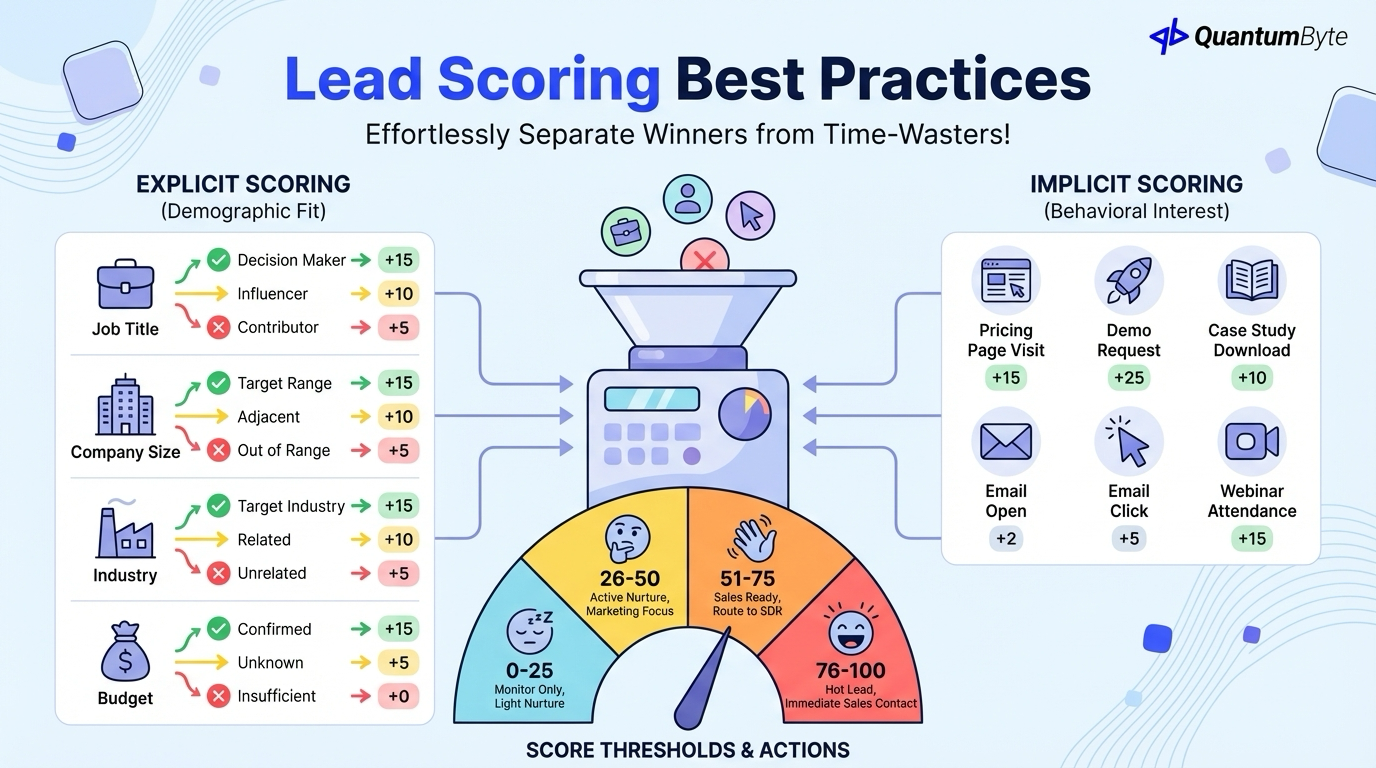
Effective lead scoring separates winners from time-wasters:
Explicit Scoring (Demographic Fit)
| Factor | High Score | Medium Score | Low Score |
|---|---|---|---|
| Job Title | Decision maker | Influencer | Individual contributor |
| Company Size | Target range | Adjacent | Out of range |
| Industry | Target industry | Related | Unrelated |
| Budget | Confirmed | Unknown | Insufficient |
Implicit Scoring (Behavioral Interest)
| Action | Score |
|---|---|
| Pricing page visit | +15 |
| Demo request | +25 |
| Case study download | +10 |
| Email open | +2 |
| Email click | +5 |
| Webinar attendance | +15 |
Score Thresholds and Actions
- Score 0-25: Monitor only, light nurture
- Score 26-50: Active nurture, marketing focus
- Score 51-75: Sales ready, route to SDR
- Score 76-100: Hot lead, immediate sales contact
Technology Options
Understanding your lead management software choices:
Marketing Automation Platforms
Examples: HubSpot, Marketo, Pardot
Cost: $50-1,000+/month | Pros: Comprehensive lead management, nurturing, landing pages | Cons: Can be complex, marketing-focused
CRM with Lead Management
Examples: Salesforce, Pipedrive, HubSpot CRM
Cost: $25-150/user/month | Pros: Lead to close in one system, sales-focused | Cons: Marketing features vary, per-user pricing scales
Custom Lead Management System
Cost: $15,000-40,000 (one-time development) | Pros: Built for your exact process, custom scoring logic, no per-user fees | Best for: Unique lead sources, complex qualification, high lead volume
| Approach | Monthly Cost | 5-Year Cost | Best For |
|---|---|---|---|
| Marketing Automation | $200-1,000 | $12,000-60,000 | Marketing-heavy |
| CRM Lead Management | $250-1,500 (10 users) | $15,000-90,000 | Sales-focused |
| Custom Built | Maintenance only | $20,000-50,000 | Unique needs |
Implementation Roadmap
Path to better lead management:
Week 1: Document Lead Sources and Qualification
List all lead sources, document current qualification criteria, map lead flow and routing, and establish baseline metrics.
Week 2: Set Up Lead Capture
Integrate website forms, connect advertising platforms, set up event/webinar capture, and test all capture paths.
Week 3: Configure Scoring and Routing
Define scoring model, configure score calculations, set up routing rules, and build nurture sequences.
Week 4: Import Existing Leads
Clean existing data, import to new system, apply scoring, and verify accuracy.
Week 5: Train and Go Live
Train sales and marketing teams, launch full operation, monitor closely, and address issues.
Case Study: Digital Agency
A digital agency generating 500+ leads monthly faced critical lead management challenges:
- Leads from multiple sources not consolidated
- 40% of leads never followed up
- No source attribution
- 8% conversion rate
- Sales blaming marketing for "bad leads"
The Solution
Custom lead management system with multi-source capture, lead scoring (budget, project type, engagement, timeline), automated routing, nurture sequences, and attribution reporting.
The Impact
| Metric | Before | After |
|---|---|---|
| Lead capture rate | 60% | 100% |
| Average response time | 24 hours | 15 minutes |
| Follow-up completion | 60% | 100% |
| Conversion rate | 8% | 14% |
| Source attribution | None | Complete |
Revenue impact: 6% conversion improvement × 500 leads/month × $15K avg project = $540,000 additional annual revenue
Conclusion: Stop the Leakage
Every lead that leaks from your pipeline is revenue walking away. Lead management software plugs the holes:
What you gain:
- 100% lead capture
- Instant response capability
- Consistent follow-up
- Intelligent prioritization
- Clear attribution
What you eliminate:
- Lost leads
- Slow response times
- Inconsistent follow-up
- Marketing/sales finger-pointing
The revenue impact is substantial—typically 50%+ improvement in conversion rates. The question is how many more leads you'll lose while deciding.
Ready to transform your lead management? Schedule a consultation to explore your lead management opportunities.
Other Guides to Explore
- Sales Automation Tools: Increase Revenue and Close Deals Faster
- CRM for Small Business: Choose the Right System to Drive Revenue Growth
- How to Automate Business Processes to Increase Revenue in 2025
- Workflow Automation Software: How to Reduce Costs and Boost Revenue
Frequently Asked Questions (FAQ)
How much does lead management software cost?
Marketing automation platforms: $50-1,000+/month. CRM with lead management: $25-150/user/month. Custom solutions: $15,000-40,000 one-time. Calculate based on your lead volume and the revenue impact of better conversion.
What's the difference between lead management and CRM?
Lead management focuses on pre-sales: capturing, scoring, routing, and nurturing leads until they're ready to buy. CRM manages the full customer lifecycle including deals, accounts, and post-sale relationships.
How do I build a lead scoring model?
Start with your best customers—what characteristics did they share? What actions did they take before converting? Score leads on those factors. Test, measure actual conversion by score, and refine continuously.
How quickly should we respond to new leads?
As fast as possible—research shows 5 minutes is ideal. Leads contacted within 5 minutes are 21x more likely to convert than those contacted in 30 minutes. Lead management automation enables instant response at scale.

